
Intercultural & Cross-Cultural Training for Global Teams
Global projects don’t fail on strategy — they fail on culture


Intercultural training for companies prepares executives and global teams for critical situations in leadership, projects and negotiations. Global-IQ® combines real-world B2B cases with scientifically grounded cultural models – delivered as tailored in-house training for medium-sized businesses and multinational corporations.
What Is Intercultural Training? (And What It Is Not)
Intercultural training — also known as cross-cultural training — is a structured professional development programme that equips managers and professionals to recognise culturally driven differences in communication, leadership and decision-making, and to handle them effectively in business. In a B2B context it typically runs one to two days and is delivered as an inhouse workshop or online seminar — either culture-general or country-specific, for example for China, Japan or India.
Forget simplistic "dos & don'ts" and superficial etiquette rules — how to hand over a business card or behave at a business dinner. These are the obvious cultural differences that everyone can see, and no deal has ever collapsed over them. If that is what an intercultural training teaches, it is simply wasted money.
Things get interesting where differences are invisible: What does hierarchy mean in meetings, in brainstorming sessions, in project and change management, or in client communication? This is where the truly damaging traps lie. In our long-standing practice advising international corporations we see the same pattern again and again: global projects rarely fail on technical competence — they fail on invisible cultural barriers.
The visible part is practically irrelevant – the invisible part is highly relevant and potentially severely damaging to your business – and it is taught at hardly any university!
Superficial, harmless differences
| Business dinner | Handshake |
| Business cards | Dress code |
| Etiquette | |
Hidden, high-risk differences
| Hierarchy in meetings | Brainstorming |
| Change management | Client communication |
| Decision-making logic | Face-saving |
| Escalation risk | Hidden cultural barriers |
Emails to Asian business partners in which senior managers are put in "CC" without prior agreement. The result: a clear signal of distrust, combined with loss of face — potentially severely damaging to the business relationship.
Professional intercultural training is therefore hard-nosed risk management. It is the deliberate development of your intercultural competence to systematically decode foreign business logics — precisely that invisible part. As long-standing practitioners and experts, we show your professionals and leaders how to turn cultural differences in communication, decision-making and cross-cultural leadership from an obstacle into a strategic lever.
Why Western Training Standards Often Fail in International Contexts
What is taught at Western business schools and training institutes — from Harvard and INSEAD to corporate academies — is professionally sound and useful. But it is built on a Western management tradition. In many non-Western countries, this management style is not perceived as the local, organically grown understanding of leadership and collaboration. Where it is taught at all, it lives in a handful of international business schools — not in the cultural mainstream.

Two parallel management worlds. Left: the Western, university-shaped style taught in business schools worldwide. Right: the local, traditionally grown management style actually practised in many non-Western economies — with its own leadership logic, its own concepts of hierarchy and its own patterns of success. If your international counterparts were educated or professionally socialised in their home country, they are highly likely to operate by the right-hand model — not the left.
What this means for effective cross-cultural training: A training that only teaches the Western playbooks and then expects the other side to understand and apply them falls systematically short. That is why our trainings start from a different point: we show your teams the logic of the local management style — which success patterns carry weight there, which communication and hierarchy rules apply, and why processes and decisions run on a different clock. The goal is not to educate the other side into our model, but to build a workable translation between two equally valid management worlds.
The most common diagnostic error we see in training practice: from the observation "they do things differently over there", people conclude the other side is unprofessional. That is wrong — they work professionally by their logic. Building exactly this translation capability is the real training objective. For structural questions in international organisations, see our intercultural management consulting.
Intercultural Management Training & Executive Seminars
For executives, senior managers, HR business partners and department heads operating internationally, we offer specialised intercultural management training that goes well beyond classic awareness-building. The focus: strategic leadership decisions in culturally divergent contexts, building resilient international team structures, and dealing with the blind spots of Western management playbooks in non-Western organisations.
Format: two-day inhouse seminar or 1:1 executive coaching with follow-up support over several months. Target group: department heads, plant managers, Heads of Sales, Heads of Purchasing, Heads of Project Management, and HR business partners with international responsibility.
What Customers Say About Our Intercultural Training
“Thank you very much for the excellent training. I came away with a great deal of valuable food for thought. Insightful, highly relevant, and immediately applicable in day-to-day business.”
“The workshop was eye-opening in so many ways. I am looking forward to putting the insights into practice.”
“Excellent training, with many highly practical examples. I would warmly recommend it to anyone working with partners in the Global South.”
The Strategic Payoff: Fewer Friction Losses, Protected Project Timelines
Cross-cultural training for international business is not a "soft" nice-to-have — it is a measurable productivity lever. When international teams talk past each other, the result is not just conflict but hard financial damage: delays, duplicated work and misfired escalations.
A German project team waits for a clear "yes" or "no" from internal project partners in Asia. What arrives is a friendly "Yes". The problem: this "Yes" frequently does not mean agreement — it means "I have heard you". The project stalls for weeks. The deadline slips — and in the end an external contractor has to be brought in, at a premium, to recover the lost time.
Our approach to intercultural management starts exactly at these business-critical points: reliability, communication, working in matrix structures, escalation and leading across cultural boundaries. We train your teams for the critical moments: How do you escalate in the US? How do you establish commitment in India? How does cross-cultural leadership work in hybrid, globally distributed teams?
Assessment: Global Leader or International Beginner?
8 brief everyday scenarios reveal if your intercultural intuition is truly business-ready.

Secure your global deadlines & project timelines
Application Areas
Formats & Transfer
We deliver inhouse and online formats in English and German — from compact workshops to intensive bootcamps with a coaching component. Concrete practice cases from your organisation and proven models such as high-/low-context communication secure the transfer into everyday work. On request, follow-up sessions make visible whether the new behaviours actually stick in the project business.
Your benefit, in one sentence:
Fewer misunderstandings, faster alignment, and teams that don't just "respect" cultural diversity but use it as a strategic performance advantage. Would you like to reduce friction losses and systematically build your intercultural competence?
Let's talk about your setting – enquire without obligation →
Intercultural Training for Your L&D Programme: Key Facts for HR
Researching a suitable intercultural or cross-cultural training as an HR manager, people development lead or L&D professional — for business units, leaders or your global workforce? Here are the key facts you need for vendor comparison and internal alignment — compact and without detours.
How the Alignment With Your HR Department Works
- Enquiry & initial call: You describe the occasion, target group and target markets — together we clarify which format fits.
- Proposal within 48 hours: You receive a concrete proposal with all key facts for your internal alignment and budget approval.
- Needs analysis with the business unit: Pre-interviews with participants and leaders — the training is tailored to real practice cases from your organisation.
- Delivery: Inhouse at your site or online, in English or German.
- Transfer & follow-up: Optional follow-up sessions that make visible whether the new behaviours stick in daily project work — your proof of effectiveness towards stakeholders.
Whether a single team training, a programme for your global workforce or a building block in an existing leadership development programme: talk to us — you will receive a tailored proposal for your people development within 48 hours.
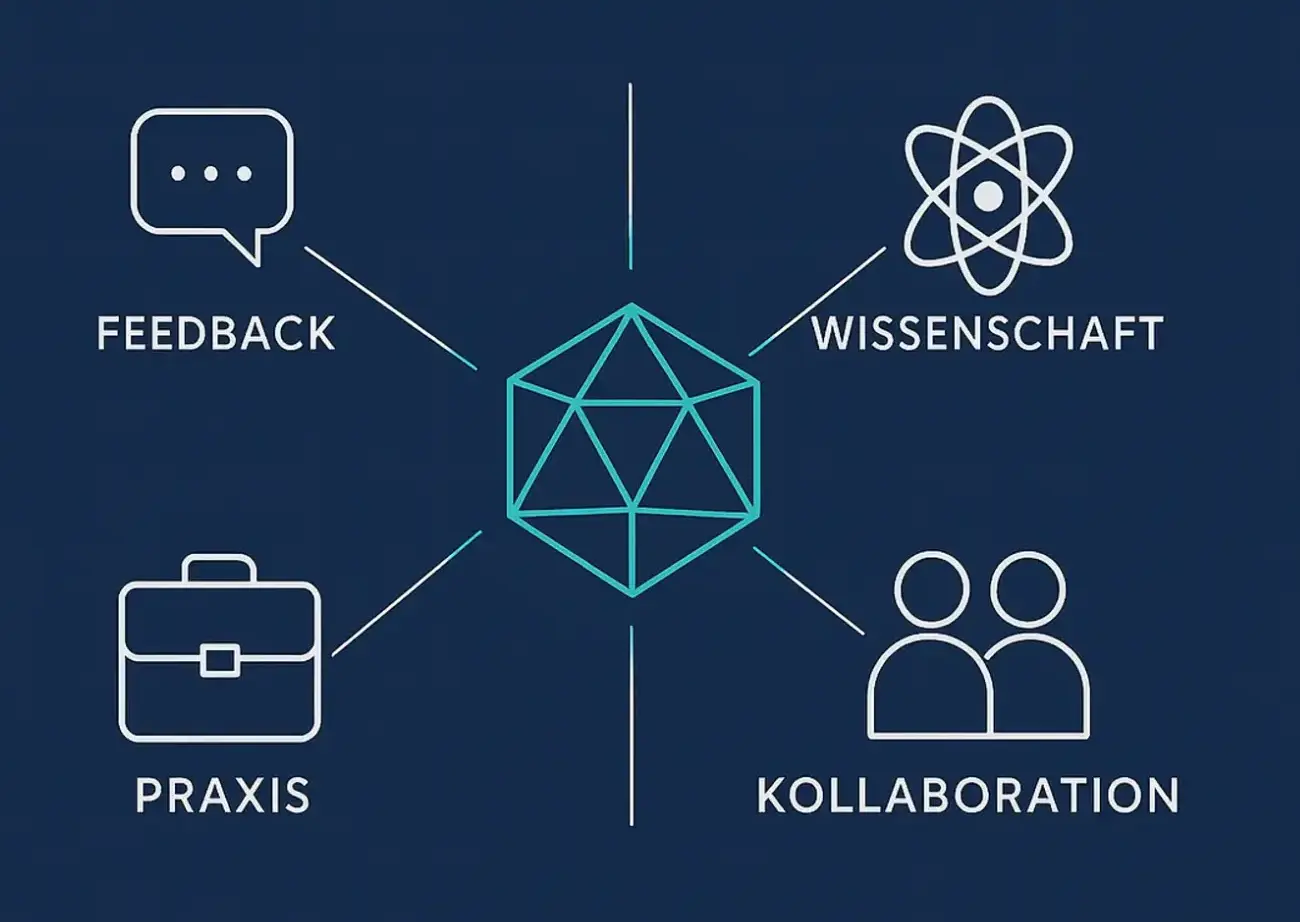
Our Method: Scientifically Grounded, Delivered for Practice
All our trainings are built on Dr. Schoen's "Fusion Learning" approach. This field-tested didactic integrates evidence-based techniques to create a lasting learning experience that is immediately applicable in day-to-day management.
→ Learn more about our methodology
Intercultural Teambuilding for Global and Virtual Teams
For multicultural, distributed teams, classic on-site teambuilding is no longer enough. Our intercultural teambuilding starts from reality: team members across five time zones, three languages, six cultural spheres — and shared deadlines nonetheless.
- Virtual communication rules — what is said in meetings, what is written in chats, what belongs in emails.
- Time-zone fairness — which colleagues carry the "night meeting" burden how often? Rotate systematically and fairly.
- Asynchronous trust-building — building trust without face-to-face time, culture-specific relationship rituals in remote setups.
- Decision-making for multicultural teams — from Western voting to Asian consensus.
Format: 1-day virtual kick-off + 3 follow-up sessions over 6–8 weeks, or a two-day on-site workshop.
Our Training Methods in Detail
We don't work with theoretical culture knowledge but with concrete tools from 15+ years of practice:
- Scientific frameworks (Hofstede, GLOBE, Trompenaars, Meyer)
- Practice-based case studies from DAX corporations and the Mittelstand
- Interactive simulations & role plays
- Cultural self-assessment tools (Cultural Intelligence Assessment)
- Transfer assignments for day-to-day work
- Follow-up coaching on request
Industry Focus & Reference Clients
Our trainings work across industries, with particular depth of practice in:
- Automotive & automotive suppliers — Magna, tier 1/2 suppliers
- Life sciences & pharma — B. Braun Melsungen
- Testing, inspection & certification — TÜV SÜD
- Manufacturing & hightech — plant engineering, machinery, electronics
- Logistics & supply chain — international networks, customs
- Energy & infrastructure — large-scale international projects
- IT & software development — nearshore teams, offshore partners
Special Module: Cross-Cultural Leadership & Global Leadership Training
Leaders face particular challenges globally: How do I motivate teams in India? How do I give critical feedback in China without triggering a loss of face?
The problem: The entire motivation and decision-making theory taught at universities and in classic leadership seminars is Western-centred. In Asia, Latin America, Africa and the MENA region, these approaches usually fail completely in practice.
Our training closes exactly this gap. We cover cross-cultural leadership specifically for these dynamic markets, build your team's cultural intelligence (CQ), and deliver field-tested strategies for:
- Leadership styles: Hierarchical vs. egalitarian (knowledge transfer from the GLOBE study).
- Decision making: Fast top-down decisions vs. relationship-driven consensus-building.
- Remote leadership: Confident virtual leadership of globally distributed, multicultural teams.
- Motivation: Culturally adequate approaches to motivating employees intrinsically — even without Western incentive systems.
- Change management: Steering transformation processes in Asia, MENA and Latin America safely and without resistance.
Training Focus for Key Global Markets
Our expertise covers specialised trainings for the world's most demanding economic regions. We prepare your teams specifically for the cultural realities of China, Japan and India. The detailed country pages are currently available in German.

Business Success in the Middle Kingdom
Master hierarchy, harmony and indirect communication in Asia's most important market.
To the China training →
Trust-Building & Hierarchy
Understand consensus-driven processes and build lasting business relationships based on respect.
To the Japan training →
Managing Complexity & Flexibility
Navigate the interplay of hierarchy and flexibility (Jugaad) in one of the world's most dynamic markets.
To the India training →Further Target Markets in Our Training Expertise
Beyond our focus markets China, Japan and India, we deliver specialised intercultural trainings for the following economic regions. Country combinations and special constellations (e.g. US–China, Germany–Vietnam, EU–MENA) on request:
- USA & Canada
- South Korea
- Vietnam
- Indonesia
- Thailand
- Taiwan
- Saudi Arabia
- UAE
- Türkiye
- Iran
- Brazil
- Mexico
- Argentina
- France
- United Kingdom
- Poland
- Russia
- Scandinavia
- South Africa
- Arab World
Secondary expertise for further countries and regional clusters (Latin America, Southeast Asia, Africa, Eastern Europe) available. We deliver inhouse at your site anywhere in Germany, Austria and Switzerland — see our German locations overview — and receive a tailored proposal within 48 hours.
The Standard Training Agenda at a Glance
Every two-day inhouse training follows a proven core structure — adapted to your team's concrete topics and target markets. The ten points at a glance:
- Collecting participants' questions and real-world challenges — the open start: where exactly is the friction in your international day-to-day right now?
- The Delegation Case — a live simulation that makes typical misunderstandings in briefing and delegation across cultural boundaries visible.
- Hierarchy in business life — differences in customer/supplier relationships and their implications, with concrete country examples.
- Working in the international matrix organisation — lateral leadership, "dotted line" conflicts, escalation paths across cultures.
- International business communication — high-context vs. low-context, email conventions, CC politics and their cultural pitfalls.
- The relativity of the Asian "Yes" — why a Japanese, Chinese or Indian "yes" is often not a yes — and how to read the real status.
- Meetings — brainstorming & co. — why Western meeting formats fail in many cultures, and which alternatives actually work.
- Building trust internationally — cognition-based vs. affect-based trust, culture-specific relationship rituals (Guanxi, Nemawashi, Wasta).
- Face-saving in strongly hierarchical regions — Face Negotiation Theory in practical application, corrective feedback without damaging the relationship.
- Answering the participants' questions and challenges — the closing frame: the concrete practice cases from point 1 are worked through with the tools developed.
This agenda is our standard scaffold. For country- or role-specific trainings (China, Japan, India, sales, leadership, procurement), individual points are deepened or extended.
↓ Thematic deep dive: Which contents the individual modules cover in detail — especially for the target markets USA, Japan, China and India — is shown in the expandable modules directly below.
Content & Format: What You Will Learn in the Intercultural Training
Our intercultural training combines scientifically grounded frameworks (Hofstede, GLOBE, Trompenaars) with hands-on practice cases from more than 500 delivered trainings. Every module is tailored to your target markets.
You will understand the six Hofstede dimensions (power distance, individualism, masculinity, uncertainty avoidance, long-term orientation, indulgence) and recognise how they shape concrete negotiation situations. You will get to know the GLOBE study as an extension, and Trompenaars' seven dimensions as an operational tool for international day-to-day business.
War story: A DAX-30 machinery manufacturer lost a €4.7m project in Saudi Arabia because the negotiation team ignored power distance (Hofstede score 95) and publicly corrected the senior decision-maker on a technical detail. With the framework as a routine check before the pitch, this would have been avoidable.
You will decode the pragmatic, performance-driven US business model. You will understand the unwritten laws of pay for performance and why business decisions in the US are based strictly on measurable KPIs and hard cost-benefit ratios — independent of personal relationships. You will also learn how to navigate the strict compliance policies of American corporations without triggering operational blockages.
War story: An automotive supplier from Baden-Württemberg tried to secure a strategic partnership in Detroit through years of personal relationship-building. US management declined because the offer did not immediately prove the required cost-benefit ratio on paper. Only when the presentation was radically restructured to "result first" did the contract materialise. Relationships are nice — but in US business, performance must be measurable.
You will learn how large Japanese companies actually make decisions: Nemawashi (informal pre-alignment behind the scenes) followed by Ringi (the formal circulation procedure). You will understand why "but they understood it in the meeting" is a dangerous Western self-deception — and how to play the pre-alignment game confidently.
War story: A German technology supplier held pitch meetings in Tokyo for months and was certain every time: "They're buying." They didn't. The reason: nobody had done Nemawashi beforehand. Our solution in the training: mapping the internal stakeholders long BEFORE the first negotiation meeting.
More on this: Intercultural Training Japan (in German)
You will understand Guanxi (the relationship network as a business asset) and Mianzi (saving/giving face) not as theoretical folklore but as operational tools. You will learn how to build stable Guanxi in the very first encounter, in which order business cards are exchanged, and which gifts carry which message.
War story: An automotive supplier lost a tier-1 contract in Shanghai because a German project lead publicly criticised the Chinese GM in an email CC — a fatal loss of Mianzi in front of his own team. Despite a technically superior solution, the contract was simply re-tendered.
More on this: Intercultural Training China (in German)
You will learn to use the Indian Jugaad mentality (frugal, creative problem-solving) as a strength instead of dismissing it as mere "improvisation". You will understand why German process detail can create distrust rather than trust in India — and how to dimension specifications correctly.
War story: A German software company sent 180-page requirement specifications to Indian development partners. The response: politely prolonged silence, then an incomplete redesign on site. In the training we show the B2B format that works: outcome definition instead of process micromanagement.
More on this: Intercultural Training India (in German)
Scientific Foundation & Evidence-Based Methodology
Our training approaches and diagnostic tools are not based on subjective judgement but on decades of empirical research in cross-cultural management and international psychology. The following primary studies form the theoretical backbone of our practice-oriented B2B strategies:
- [1] Culture in organisations: Hofstede, G. (1980). Culture and Organizations. International Studies of Management & Organization.
To the publication (Taylor & Francis) ➜ - [2] Context communication: Hall, E. T. Context and Culture (High- vs. Low-Context Communication). Computer Science Topics.
To the publication (ScienceDirect) ➜ - [3] Global leadership (GLOBE): House, R. J., et al. (2001). Project GLOBE: An Introduction. Journal of World Business.
To the publication (ScienceDirect) ➜ - [4] Cross-cultural trust-building: Chua, C. H., et al. (2008). Differential effects of cognition- and affect-based trust. Management and Organization Review.
To the publication (Cambridge University Press) ➜ - [5] Cross-cultural negotiation: Schoen, R. (2021). Getting to Yes in the cross-cultural-context. International Journal of Conflict Management.
To the publication (Emerald Insight) ➜

Frequently Asked Questions About Intercultural Training
What is the difference between intercultural and cross-cultural training?
Who is the intercultural training designed for?
Do you also deliver the training online?
How long does an intercultural training typically take?
Which countries and cultures do you cover?
Where do you deliver English-language intercultural training?
What does an intercultural training cost?
Which methods do you use in the training?
How quickly can you deliver a training?
Why is intercultural training important?
What are typical examples of interculturality in a business context?
What are the four core elements of intercultural competence?
Do you offer intercultural preparation for expats and international assignments?
How do you support HR and people development in vendor selection and internal alignment?
Do participants receive a certificate of participation?
Can the training be integrated into existing people development programmes?
Start improving your international collaboration now
Request Quotation now: