
Edward T. Hall's Four Cultural Dimensions in Cross-Cultural Studies
A structured reference with primary sources and peer-reviewed critique
Edward T. Hall (1914–2009) was an American anthropologist whose fieldwork with the U.S. Foreign Service Institute (1950–1955) and subsequent monographs defined four cultural dimensions for the analytical study of cross-border communication: (1) High-Context vs. Low-Context Communication, (2) Monochronic vs. Polychronic Time Orientation, (3) Information Flow, and (4) Proxemics — the cultural coding of physical space. His central proposition — "Culture is communication and communication is culture" (Hall, 1959/1990, p. 186) — reframed cross-border misunderstandings as structural rather than personal phenomena and laid the vocabulary on which most later frameworks (Hofstede, Trompenaars, GLOBE) explicitly or implicitly build.
In our training and advisory practice, Hall's framework is most often quoted for its catchy dichotomies — and most often misused when those dichotomies are treated as deterministic country profiles. Its real analytical value is diagnostic vocabulary, not predictive classification.
Cross-Cultural-Management Studies — Hall as the Starting Point
In global business, intercultural management, cultural diversity, and international cooperation are decisive factors for long-term success. Professionals operating across borders encounter diverse value systems, communication styles, and expectations — whether in international negotiations, supplier relations, multicultural team leadership, or day-to-day project management. Almost every modern analytical tool used to make sense of this complexity — from Hofstede's dimensions to the GLOBE Study — builds, explicitly or implicitly, on the conceptual ground that Edward T. Hall laid in the 1950s, 60s, and 70s.
High-Context vs. Low-Context Communication — Hall's Central Dichotomy
High-Context communication denotes cultural systems in which a substantial share of the message is transmitted implicitly — through relationship, shared background, silence, and non-verbal signals — while the explicit verbal code carries a comparatively smaller share of the meaning. Low-Context communication denotes the inverse: meaning is transported predominantly through the explicit verbal code, with limited reliance on shared background. Hall introduced the distinction in Beyond Culture (1976, pp. 91–101) and treated it as a continuum, not a binary. Contemporary meta-analyses — most systematically Cardon's review of 224 articles between 1990 and 2006 (Cardon, 2008) — show that the propositions most frequently cited in textbooks have been tested less often than assumed, and where tested, results are mixed, particularly around directness.
Structural comparison
Country references reproduce Hall's own case-based positioning and are heuristic, not empirically validated cut-offs. The systematic review by Kittler, Rygl & Mackinnon (2011) shows that country-level classifications along the High-/Low-Context axis are regularly reproduced in the literature without robust empirical grounding.
An underappreciated case: Germany as an ambiguous data point
The textbook classification of Germany as a paradigmatic Low-Context culture is analytically productive but empirically incomplete. Two domains of professional discourse in Germany exhibit substantial High-Context features: parliamentary and diplomatic communication, in which disagreement is regularly formulated through allusion, procedural indirection, and pre-negotiated formulations rather than open confrontation; and the German qualifiziertes Arbeitszeugnis (statutory reference letter), whose regulated code requires that all evaluations be positively framed, with critique encoded through a conventionalised system of graded phrasing. Both institutions demonstrate that the Low-Context / High-Context distinction operates per communicative domain, not per nation — a point Hall himself made in Beyond Culture (1976, pp. 105–106), but which is regularly lost when the country-level shorthand is applied uncritically.
The practical consequence for international management is directly derivable: the same German counterpart may operate in a Low-Context register in an engineering review and shift to a High-Context register in a governance or personnel discussion. Treating the country label as a fixed profile obscures precisely the intra-cultural variance that Hall's framework, in its original 1976 formulation, was designed to make visible.
Proxemics — The Cultural Coding of Physical Space
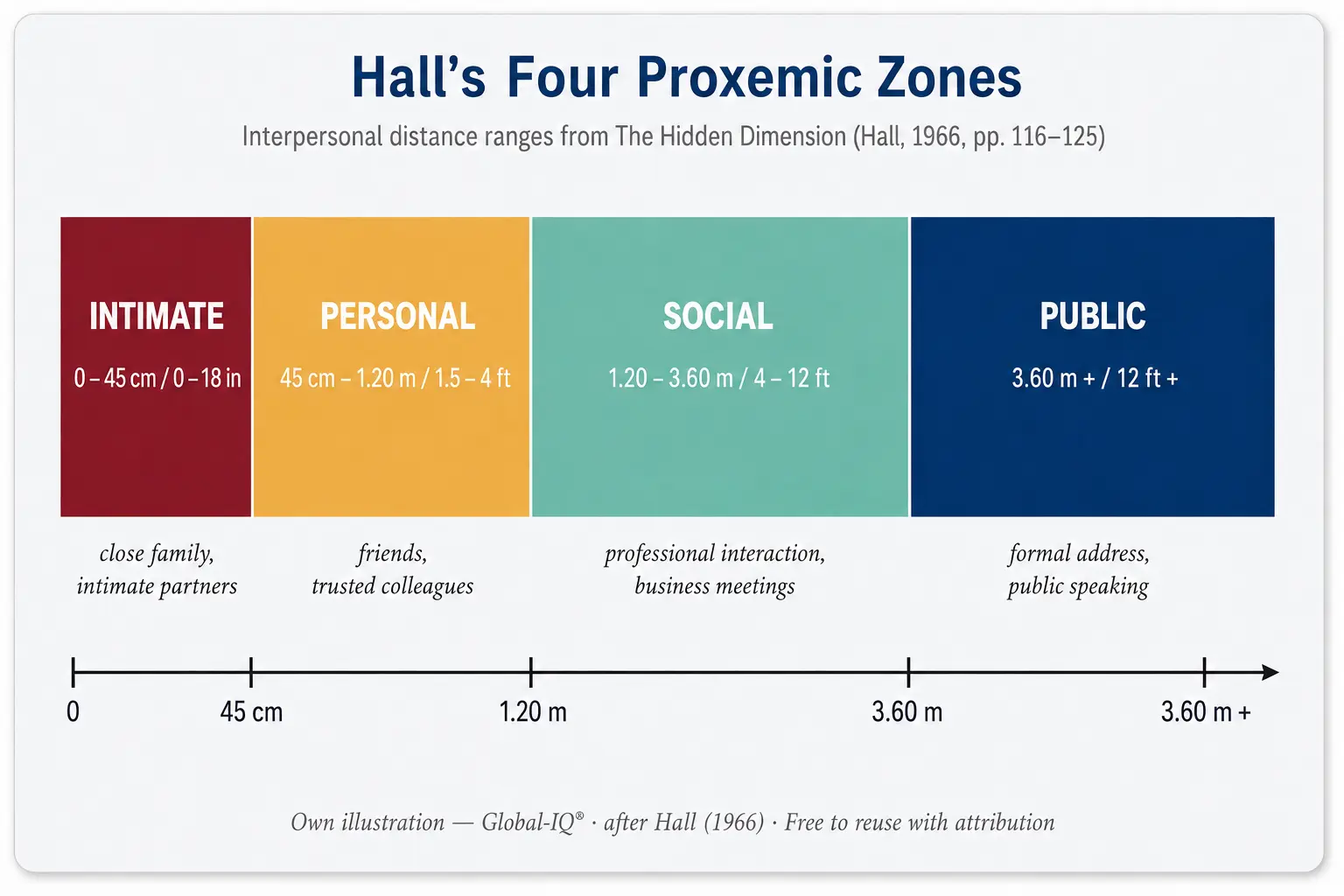
Proxemics, a term coined by Edward T. Hall, is the systematic study of the cultural rules governing the use of interpersonal space. In The Hidden Dimension (Hall, 1966, pp. 116–125), Hall proposed a fourfold classification of interpersonal distance zones — intimate, personal, social, and public — and argued that the boundaries of each zone are culturally rather than biologically defined. The distances below are Hall's original values, empirically derived from North American middle-class informants (Hall, 1966, p. 116) and explicitly presented as a reference case, not a universal standard.
Cultural variance of the four zones
Hall himself insisted that the ratio of the four zones is largely preserved across cultures, but the absolute values vary systematically (Hall, 1966, pp. 129–153). The personal-distance boundary in Northern European and North American business interaction is typically located between 60 and 90 cm; in a range of Mediterranean, Latin American, and Arab-speaking business contexts, the same functional distance is regularly observed between 30 and 60 cm. What one register codes as respectful attention (larger distance), another codes as evasive or dismissive (larger distance again); what one register codes as normal engagement (smaller distance), another codes as intrusive. Neither reading is empirically wrong — the two operate under different conventions.
Note on empirical status: subsequent quantitative studies of interpersonal distance across cultures — notably Sorokowska et al. (2017, Journal of Cross-Cultural Psychology) with data from 8,943 participants across 42 countries — partly corroborate Hall's directional intuitions on cross-cultural variance while showing that the country-by-country values do not always align with Hall's original 1966 case observations. Proxemics remains an active empirical research field.
Monochronic vs. Polychronic Time — A Hall Snapshot
Among Hall's dimensions, Time Orientation is the one most underestimated in international business. While communication styles are usually discussed in negotiation prep, time logic is treated as universal — and that is exactly where projects derail. Monochronic cultures treat time as linear and segmentable: one task at a time, deadlines as commitments. Polychronic cultures treat time as plural and relational: multiple threads at once, schedules subordinated to relationships. The illustration below shows the relative positioning of selected societies on the Monochronic-Polychronic spectrum — heuristic, drawn from Hall's case-based observations rather than empirical scoring:
The practical relevance is immediate: a monochronic project manager who reads a polychronic counterpart as "unreliable" because a deadline shifts — and a polychronic counterpart who reads the monochronic manager as "rigid" or "transactional" because a relational pause is refused — have both fallen into the same Hall-style misreading. Recognising the time logic of the other side is often the difference between a project that closes on schedule and one that loses six months in misaligned expectations.
German certification body × Indian regional operations — a time-orientation misreading
A German technical certification and testing organisation with a subsidiary operation in India experienced repeated deadline slippage on multi-workstream audit projects. Internal reporting framed the pattern as a compliance and commitment problem — "they do what they want" was the recurring formulation in Frankfurt.
The case illustrates a proposition Hall articulated in The Dance of Life (1983, pp. 42–58): where a monochronic and a polychronic register meet without institutional adaptation, the monochronic side systematically misreads the polychronic side as unreliable, and the polychronic side systematically misreads the monochronic side as inflexible. Neither reading is factually correct; both are structurally predictable.
Critical Reception — What the Peer-Reviewed Meta-Analyses Say
Hall's framework has been simultaneously the most cited and most empirically under-validated set of constructs in intercultural studies. Cardon's meta-analysis of Hall's contexting model — covering 224 articles in business and technical communication journals between 1990 and 2006 — documents that the contexting propositions which appear most often in textbooks have been tested far less often, and that the propositions actually tested frequently fail to confirm Hall's intuitions, especially around directness. A second peer-reviewed assessment by Kittler, Rygl and Mackinnon provides a systematic review of Hall's high-/low-context concept and confirms that the popular two-pole classification of countries is regularly reproduced without robust empirical grounding. For the practitioner, this means: Hall's vocabulary remains the most efficient introduction to cross-cultural sensitisation, but Hall's country labels are not a substitute for situation-specific analysis.
Key Contributions — Why Hall Still Matters
- Analytical vocabulary: Hall gave the field a working language — High-Context, Low-Context, Monochronic, Polychronic, Proxemics — without which most modern cross-cultural training would have nothing to teach.
- Communication as culture: By collapsing the conceptual gap between "culture" and "communication", Hall reframed misunderstandings as structural rather than personal — a shift that still underpins serious negotiation training today.
- Time as a cultural variable: Long before project management research treated tempo as a hard variable, Hall identified time logic as a measurable axis of cultural difference — with direct consequences for deadlines, decision rhythms, and meeting choreography.
- Proxemics: Hall's empirical work on personal space and spatial conduct anticipated decades of later research on body language and physical distance in business contexts.
- A heuristic, not a doctrine: The most productive way to use Hall today is as a starting heuristic for sensitisation — combined with peer-reviewed cultural frameworks (Hofstede, GLOBE) for empirical depth.
A practitioner reading. Clients rarely name Hall in a workshop — most have not read a single monograph and would not recognise the terms monochronic or proxemics if put to them directly. Yet every project manager working across time-orientation registers, every negotiator across a context-load gap, and every expatriate calibrating personal distance in a new market has been operating inside Hall's framework, whether they know it or not. That is the reason the vocabulary endures — not because every proposition is empirically vindicated, but because Hall names, more efficiently than any successor, the friction pattern that international teams still produce every day.
Conclusion
Edward T. Hall remains the conceptual anchor of intercultural studies for international business. His central insight — that culture is the operating system through which we encode and decode communication, information, time, and space — turned ad hoc observations about "foreign business habits" into a structured analytical field. The honest reading, supported by the peer-reviewed meta-analyses cited above, is that Hall's country-level labels are heuristic, not deterministic. The categories endure precisely because they help managers ask better questions: What context-load is this counterpart operating with? What time logic is shaping their decision rhythm? Those questions, asked early, prevent expensive mistakes later.

About the Author: Dr. Raphael Schoen
Ph.D. in Negotiation · HHL Leipzig · CEO Schoen Negotiation Institute
Dr. Raphael Schoen completed his doctorate on cross-cultural negotiation at HHL Leipzig Graduate School of Management. His systematic review of cross-cultural negotiation research (Management Review Quarterly, vol. 71, 2021, DOI 10.1007/s11301-020-00187-5) and his critical review of the four principles of principled negotiation across cultures (International Journal of Conflict Management, vol. 33, 2022, DOI 10.1108/IJCMA-12-2020-0216) engage directly with the empirical limitations of Western-shaped intercultural frameworks — including Hall's. His publications are cited in the reference sections of the Wikipedia articles on Negotiation and Getting to Yes, and have been read more than 20,600 times on ResearchGate.
- Ph.D. in Negotiation (HHL)
- MBA HHL Leipzig
- Negotiation Mastery (HBS Online)
- Lead Negotiation Coach, HHL Negotiation Club
- IJCMA vol. 33 (2022)
- MRQ vol. 71 (2021)
- 20,600+ ResearchGate reads
Frequently Asked Questions about Edward T. Hall
Who was Edward T. Hall and why does he matter for international business?
Edward T. Hall (1914–2009) was an American anthropologist whose work in the US Foreign Service and at the Washington School of Psychiatry laid the foundations of modern intercultural studies. He matters for international business because almost every analytical vocabulary still used in cross-cultural management — High-Context vs. Low-Context Communication, Monochronic vs. Polychronic Time, Proxemics — originates with him.
What is the difference between High-Context and Low-Context cultures?
In High-Context cultures (e.g., Japan, China, the Arab world), a large share of the message is carried implicitly — in relationship, status, silence, and shared background. In Low-Context cultures (e.g., Germany, the USA, Scandinavia), meaning is transported predominantly through the explicit verbal code: what is said is what is meant. Hall introduced the distinction in Beyond Culture (1976), and it remains the most cited heuristic in cross-cultural training.
What does Monochronic vs. Polychronic mean in practice?
Monochronic cultures treat time as linear and segmentable — one task at a time, deadlines as commitments, schedules as binding. Polychronic cultures treat time as plural and relational — multiple threads simultaneously, relationships taking priority over rigid schedules. In practice, this distinction explains why a "missed" deadline can be a serious breach in Switzerland and an unremarkable adjustment in Saudi Arabia.
Has Hall's framework been empirically validated?
Only partly. Peer-reviewed meta-analyses by Cardon (2008) and Kittler, Rygl & Mackinnon (2011) show that Hall's most-cited propositions — particularly the country-level High-Context / Low-Context classification — have been adopted in textbooks far more often than they have been tested. Where they have been tested, results are mixed. Hall's framework therefore remains the best available analytical vocabulary, but should be used as a heuristic, not as a deterministic country profile.
How does Hall's work relate to Hofstede and the GLOBE Study?
Hall provided the qualitative vocabulary; Hofstede operationalised culture quantitatively with his Cultural Dimensions; the GLOBE Study extended Hofstede with a much larger empirical base (62 societies, 17,000+ managers) and added the methodological distinction between cultural practices and cultural values. Hall, Hofstede, and GLOBE are best read sequentially — not as competitors but as a progression from sensitising heuristics to empirically validated dimensions.
What is Hall's proxemics theory?
Proxemics, a term coined by Hall in The Hidden Dimension (1966), is the systematic study of the cultural rules governing the use of interpersonal space. Hall proposed a fourfold classification of distance zones — intimate (0–45 cm), personal (45 cm–1.20 m), social (1.20–3.60 m), and public (3.60 m+) — and argued that the boundaries are culturally rather than biologically defined. Subsequent quantitative research (e.g. Sorokowska et al., 2017) partly corroborates the directional variance while refining the country-level values.
Where did Edward T. Hall collect his data?
Hall's fieldwork was conducted primarily during his service with the U.S. Foreign Service Institute (1950–1955), where he trained American diplomats and technical assistance personnel for postings abroad. Later fieldwork included ethnographic studies of Navajo and Hopi communities and observational work in Japan, Germany, France, and the Arab-speaking world. His method was primarily qualitative and case-based rather than survey-based, which is one of the reasons subsequent researchers (Cardon 2008; Kittler et al. 2011) have called for stronger empirical validation of the country-level claims.
What did Hall mean by "Beyond Culture"?
In Beyond Culture (1976), Hall's argument was that culture operates largely below the threshold of conscious awareness — as a system of implicit rules that people follow without being able to articulate them. His call to move "beyond culture" was a call to make those implicit rules explicit, so that cross-cultural encounters could be analysed structurally rather than moralised as good or bad behaviour. The book is the source of the High-Context / Low-Context distinction in its most cited form.
How does Hall's framework relate to Erin Meyer's The Culture Map?
Erin Meyer's eight-dimension model (INSEAD, 2014) is a direct methodological descendant of Hall. Meyer's "Communicating" scale is a refinement of Hall's High-Context / Low-Context axis; her "Scheduling" scale operationalises Hall's Monochronic / Polychronic distinction with observational anchor points; her "Disagreeing" and "Evaluating" scales extend Hall's original two-pole logic into managerially usable ranges. For practitioners, Meyer's framework is often the more accessible entry point; for structural depth and historical grounding, Hall remains the source.
Cite this reference page
Formatted for academic writing. Update the access date before submission.
APA (7th edition)
Schoen, R. (2026). Edward T. Hall's four cultural dimensions in cross-cultural studies. Global-IQ Institute. Retrieved [DAY MONTH YEAR], from https://global-iq.org/edward-t-hall/
BibTeX
@online{schoen_hall_2026,
  author  = {Schoen, Raphael},
  title   = {Edward T. Hall's Four Cultural Dimensions in Cross-Cultural Studies},
  year    = {2026},
  publisher = {Global-IQ Institute},
  url     = {https://global-iq.org/edward-t-hall/},
  urldate = {YYYY-MM-DD}
}
Chicago (author-date)
Schoen, Raphael. 2026. "Edward T. Hall's Four Cultural Dimensions in Cross-Cultural Studies." Global-IQ Institute. https://global-iq.org/edward-t-hall/.
This page is licensed as an editorial reference under standard copyright. Illustrations marked free to reuse with attribution may be reused with the following credit: „Own illustration — Global-IQ® · after Hall (1966/1983)". For primary sources, please cite Hall directly.
💡 From Hall's Communication Models to Business Practice
Scientific models—like Edward T. Hall's High and Low Context communication—provide a strong foundation. But how do you apply this knowledge when a direct "No" from a Western manager causes a complete loss of face for an Asian business partner?
Pure communication theory doesn't protect against costly cultural pitfalls or stalled negotiations. The real solution lies in a targeted method transfer for your everyday global business.
Learn the practical application for your team:
Go to Intercultural Training for Companies ➜
Download: Edward T. Hall’s Context Communication, Monochronic/ Polychronic and other Cultural Concepts
Understanding Working across Cultures for Study and Training.