
Erin Meyer and the Culture Map: What the Eight Cultural Scales Offer—and Where They Reach Their Limits
Populariser or cross-cultural reference? An assessment based on 15 years of training experience, examining which scales are most useful in practice.
Erin Meyer is a populariser in the best sense of the word. She has brought cross-cultural management from the academic ivory tower into the meeting room through a visual framework that executives around the world actually use. In our consulting experience over the past ten years, her observations—particularly on Leading, Trusting and Disagreeing—have proved more useful in practice than the corresponding concepts offered by Hofstede and GLOBE. Methodologically, however, the framework does not provide comparable published statistical evidence or peer-reviewed validation.
In our training and consulting practice at the intersection of negotiation and cross-cultural research, we observe that Meyer's Culture Map is by far the most frequently used framework in executive training, yet also one with a particularly limited methodological foundation. This tension between practical usefulness and limited academic evidence is central to our assessment of her work.
| Field | Details |
|---|---|
| Born | 22 August 1971 (USA) |
| Position | Professor at INSEAD Business School, Fontainebleau (France) and San Francisco |
| Principal work | The Culture Map: Breaking Through the Invisible Boundaries of Global Business (PublicAffairs, 2014); German edition: Die Culture Map: Ihr Kompass für das internationale Business (Vahlen, 2018) |
| Second work | No Rules Rules: Netflix and the Culture of Reinvention (with Reed Hastings, Penguin, 2020); German edition: Keine Regeln: Warum Netflix so erfolgreich ist (Econ, 2020) |
| Recognition | Named among HR Magazine's ‘30 Most Influential Thinkers’ in 2017; regularly featured by Thinkers50 |
| Method | An eight-scale framework based on qualitative interviews with executives in international companies; no comparable peer-reviewed empirical validation |
Who is Erin Meyer?
Erin Meyer was born in the USA in 1971 and now teaches at INSEAD Business School —one of the world's leading business schools, with locations in Fontainebleau, Singapore, Abu Dhabi and San Francisco. She directs its executive programme ‘Managing Cultural Differences’. Her career began in a way unusual for a business-school professor: she spent two years with the Peace Corps in Botswana before completing an MBA at the University of Hawai'i and subsequently joining INSEAD. This combination of practical experience in another culture and academic reflection continues to shape her work.
Her international breakthrough came with The Culture Map (2014), which has been translated into more than twelve languages and is widely referenced in executive coaching on cross-cultural issues. Her second book with Reed Hastings, No Rules Rules (2020), on Netflix's organisational culture, further raised her profile as a speaker. She writes regularly for Harvard Business Review and advises major German companies, Fortune 500 corporations and international institutions.
The eight Culture Map scales at a glance
Meyer's central contribution is an eight-scale framework on which countries occupy positions relative to one another. Each scale has two poles and addresses a specific business situation. Representing countries as points on horizontal axes has changed how cross-cultural training is taught around the world.
1. Communicating
Low-context communication (explicit and precise) versus high-context communication (implicit and dependent on context).
USA / Netherlands ↔ Japan / China
2. Evaluating
Direct negative feedback (open and unvarnished) versus indirect negative feedback (softened and face-saving).
Netherlands / Russia ↔ Japan / Indonesia
3. Persuading
Principles-first persuasion (deductive and conceptual) versus applications-first persuasion (inductive and practical).
Germany / France ↔ USA / UK
4. Leading
Egalitarian leadership (flatter hierarchies and less status distance) versus hierarchical leadership (steeper hierarchies and clearer status differences).
Scandinavia ↔ Japan / South Korea / Nigeria
5. Deciding
Consensual decision-making (building agreement beforehand) versus top-down decision-making (the leader decides and the team implements).
Japan / Sweden ↔ China / Russia
6. Trusting
Task-based trust (built through competence) versus relationship-based trust (built through personal relationships).
Germany / USA ↔ China / Saudi Arabia
7. Disagreeing
Confrontational disagreement (debate is productive) versus avoiding confrontation (public conflict can damage relationships).
France / Israel ↔ Japan / Thailand
8. Scheduling
Linear time (time as a resource and strict planning) versus flexible time (time as contextual and adaptable).
Germany / Japan ↔ India / Middle East
In our training experience, the scales highlighted in green— Leading, Trusting, Disagreeing and, with some reservations, Evaluating —represent Meyer's strongest distinctive contribution. The next section explains why.
Which of the eight scales work best? An assessment from practice
After more than 15 years of training and consulting with executive teams from major corporations, mid-sized companies and international institutions, we assess Meyer's eight scales differently. They are not equally strong. In our view, three are more useful in practice than the corresponding Hofstede or GLOBE concepts; the others largely present established cross-cultural ideas in a new format.
Leading: the clearest account of power distance in practice
Hofstede's Power Distance Index (PDI) measures cultural power distance at an abstract level. Meyer's Leadingscale translates this dimension into behaviour: how do employees speak to their manager? Do they use first names? Do they disagree in meetings? Does the manager set the agenda or expect contributions? This is operational knowledge that can be used immediately in training. An important contribution is the distinction between hierarchical and authoritarian behaviour. Scandinavia and the USA can both be relatively egalitarian while differing in decision-making logic. Hofstede's model captures this distinction less directly.
Trusting: the strongest scale in the framework
The distinction between Task-based Trust (trust built through competence and reliability) and Relationship-based Trust (trust built through personal closeness and relationships) is analytically elegant and practically important. It helps explain why German sales teams can struggle in China: they may overlook relationship-building even when their products and prices are competitive. The scale closely corresponds to Roy Chua's research on cognition-based and affect-based trust. Meyer has popularised the distinction rather than providing new empirical validation of it.
Disagreeing: the most concrete guidance for conflict situations
Whether and how disagreement is experienced as productive or destructive is a costly blind spot in international meetings. Meyer's scale illustrates how an exchange understood as engaged debate in Israel or France may be experienced as damaging to relationships in Japan or Thailand. Related insights have an empirical basis in Ting-Toomey's face-negotiation theory, but Meyer's two-pole presentation is considerably quicker to explain in training.
The remaining scales: useful, but less distinctive
In our assessment, the other five scales—Communicating, Persuading, Deciding, Scheduling and, with some reservations, Evaluating—are useful, but they are not Meyer's central contribution. Communicating presents Hall's high-context/low-context distinction in a new visual form. Scheduling draws on Hall's monochronic/polychronic distinction. Persuading and Deciding can be related to GLOBE concepts. These scales can be explained in training without referring to Meyer; in our assessment, their main value lies in presentation rather than substantially new concepts.
Frequently asked questions about Erin Meyer and the Culture Map
Who is Erin Meyer?
Erin Meyer (born 22 August 1971) is an American author and professor at INSEAD Business School in Fontainebleau, France. She wrote the international bestseller The Culture Map (2014) and co-authored No Rules Rules (2020) with Netflix founder Reed Hastings. Before her academic career, she worked with the Peace Corps in Botswana. She now teaches and advises executive teams worldwide on cross-cultural management.
What is Erin Meyer's Culture Map?
The Culture Map is a framework with eight cultural scales on which countries occupy relative positions: Communicating, Evaluating, Persuading, Leading, Deciding, Trusting, Disagreeing and Scheduling. Each scale has two poles and addresses a concrete business situation. Horizontal axes make the framework easy to use in executive training, where it is widely referenced.
What are Erin Meyer's eight cultural dimensions?
The eight scales are: (1) Communicating —low-context versus high-context communication. (2) Evaluating —direct versus indirect negative feedback. (3) Persuading —principles-first versus applications-first persuasion. (4) Leading —egalitarian versus hierarchical leadership. (5) Deciding —consensual versus top-down decision-making. (6) Trusting —task-based versus relationship-based trust. (7) Disagreeing —confrontational versus confrontation-avoiding approaches. (8) Scheduling —linear versus flexible time.
How does Meyer's Culture Map differ from Hofstede's cultural dimensions?
Hofstede's cultural dimensions—Power Distance, Individualism, Masculinity, Uncertainty Avoidance, Long-Term Orientation and Indulgence—come from a quantitative research tradition initially based on a large IBM study. Meyer's Culture Map draws on qualitative interviews and does not provide a comparable quantitative evidence base. In practice, Meyer translates many related concepts into concrete behavioural scales that are accessible in training. For more detail, see our Hofstede overview.
Which Culture Map scales are most useful?
Based on 15 years of training practice, we consider three scales particularly useful. Leading (egalitarian/hierarchical) makes power distance concrete through observable behaviour. Trusting (task-based/relationship-based) is analytically elegant and operationally important, particularly in work involving Asia and the Middle East and North Africa. Disagreeing (confrontational/avoids confrontation) provides concrete guidance for international conflict situations. The other five scales are useful but less distinctive in our assessment.
What are the main criticisms of Erin Meyer's Culture Map?
The principal methodological criticism is that the framework does not provide a peer-reviewed quantitative basis comparable to large-scale cultural studies, with transparent country datasets, representative samples or factor analysis. Precise numerical placements should therefore not be treated as independently verified measurements. This limits academic use. For executive training, we nevertheless find its visual clarity and practical accessibility valuable.
Where does Erin Meyer live?
Erin Meyer divides her time between Fontainebleau in France and San Francisco in the USA. Her family's experience of different cultural environments also informs her sensitivity to the issues addressed in her work.
Is The Culture Map available in German?
Yes. The German edition was published by Vahlen in 2018 under the title Die Culture Map: Ihr Kompass für das internationale Business. The translation is useful, although in our assessment some nuances are clearer in the original English wording. We recommend the English original for training purposes.
Is there a Culture Map tool or test?
Erin Meyer offers a commercial country-mapping tool through her business, allowing users to compare cultural profiles. Such tools can support reflection. For robust intercultural assessment in organisations, we recommend combining several diagnostic approaches; see our overview of intercultural competence.
What is Meyer's Netflix book, No Rules Rules?
No Rules Rules (2020, with Reed Hastings) examines Netflix's organisational culture, particularly radical candour, high individual responsibility and limited procedural controls. It is an interesting complement for cross-cultural discussions, but its central subject is organisational culture rather than national culture. For our training purposes, The Culture Map remains the more relevant book.
Where does Meyer fit alongside Hofstede, GLOBE and Trompenaars?
Meyer's main contribution is practical synthesis rather than foundational quantitative research. Her approach differs from Hofstede (large-scale quantitative research), GLOBE (17,300 managers) and Trompenaars (seven dimensions developed through questionnaires with executives). She has translated complex cross-cultural research into a language managers can use. In our assessment, her value lies primarily in making ideas usable rather than establishing new quantitative findings.
Cross-Cultural Frameworks in Practice
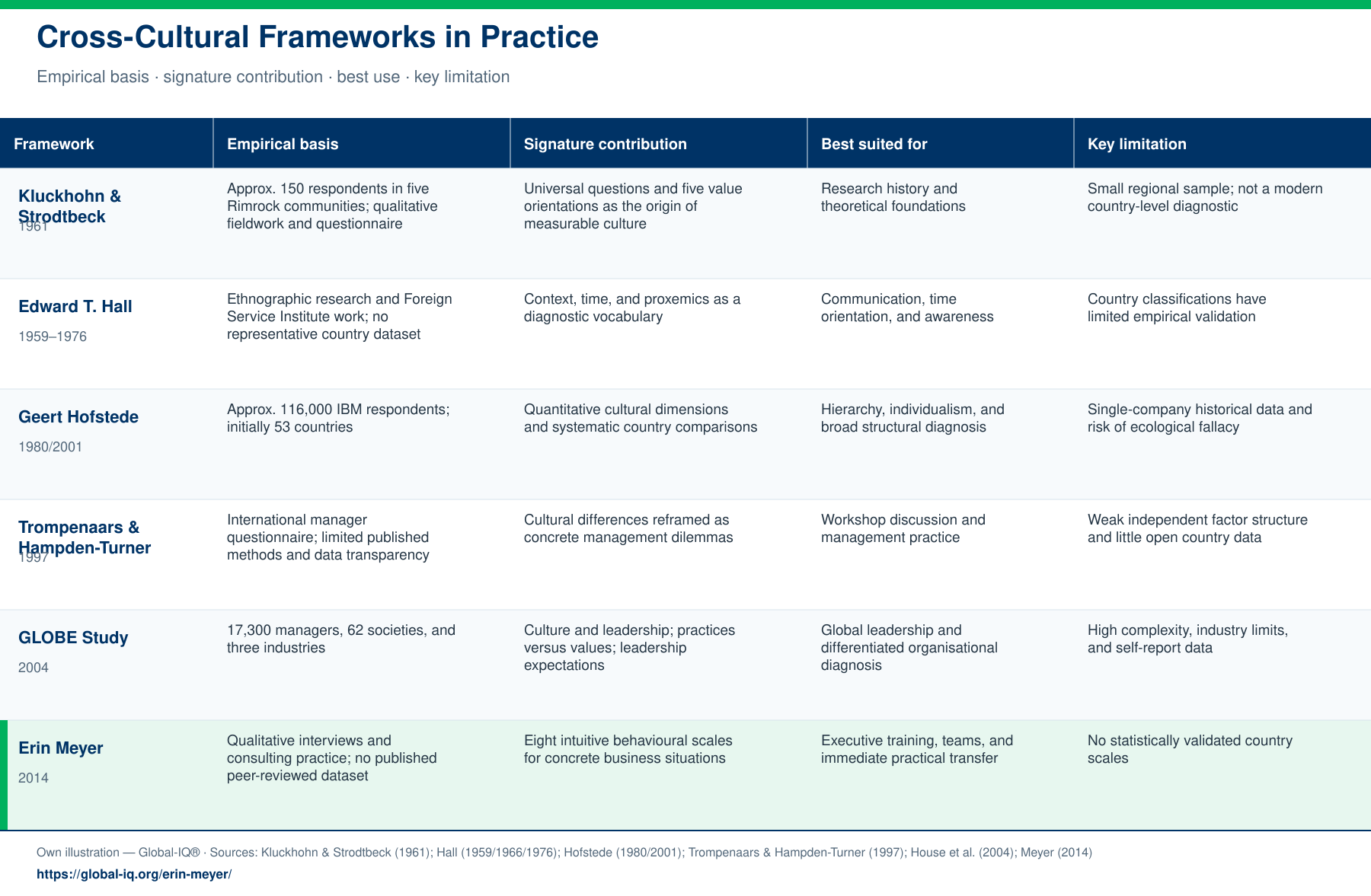
Read the comparison as a text table
| Framework | Empirical basis | Signature contribution | Best suited for | Key limitation |
|---|---|---|---|---|
| Kluckhohn & Strodtbeck 1961 | Approx. 150 respondents in five Rimrock communities; qualitative fieldwork and questionnaire | Universal questions and five value orientations as the origin of measurable culture | Research history and theoretical foundations | Small regional sample; not a modern country-level diagnostic |
| Edward T. Hall 1959–1976 | Ethnographic research and Foreign Service Institute work; no representative country dataset | Context, time and proxemics as a diagnostic vocabulary | Communication, time orientation and awareness | Country classifications have limited empirical validation |
| Geert Hofstede 1980/2001 | Approx. 116,000 IBM respondents; initially 53 countries | Quantitative cultural dimensions and systematic country comparisons | Hierarchy, individualism and broad structural diagnosis | Single-company, historical data and risk of ecological fallacy |
| Trompenaars & Hampden-Turner 1997 | International manager questionnaire; limited published methods and data transparency | Cultural differences reframed as concrete management dilemmas | Workshop discussion and management practice | Weak independent factor structure and little open country data |
| GLOBE Study 2004 | 17,300 managers, 62 societies and three industries | Culture and leadership: practices versus values; leadership expectations | Global leadership and differentiated organisational diagnosis | High complexity, industry limits and self-report data |
| Erin Meyer 2014 | Qualitative interviews and consulting practice; no published peer-reviewed dataset | Eight intuitive behavioural scales for concrete business situations | Executive training, teams and immediate practical transfer | No statistically validated country scales |
Sources: Kluckhohn & Strodtbeck (1961); Hall (1959/1966/1976); Hofstede (1980/2001); Trompenaars & Hampden-Turner (1997); House et al. (2004); Meyer (2014). Own synthesis; assessments of practical usefulness are editorial judgments, not a statistical ranking.
💡 From the Culture Map to Business Practice
Meyer's Culture Map provides a practical vocabulary for international collaboration. How can your team use it to clarify leadership expectations, build trust and handle disagreement across cultures?
Pure theoretical knowledge doesn't protect against costly cultural pitfalls. The real solution lies in a targeted method transfer for your everyday global business.
Learn the practical application for your team:
Go to Intercultural Training for Companies ➜